Thursday, October 27, 2011

BEE #6: Cambridge Beginnings (The Friendly Toast and the Charles)

Last weekend was less of a single adventure and more of a compilation of smaller adventures.

On Friday I had to attend my first of four Responsible Conduct of Research (RCR) seminars, which are required  for all students funded by NSF grants.  Basically they are two-hour sessions that use case studies to foster conversation on ethics in research.  The topic for the first one was why fabricating data and/or lying about your results is not how research should be done.  And yes...the conclusions that you just drew and assumptions you made just from reading that last statement are the same conclusions you draw after discussing it in depth for two hours in heterogeneous small groups.  But I suppose there were good points made by some and that some people probably needed the reminder.  I was reminded not to lie about my results, learned how to use the BU shuttle to get from the main campus to the med. campus, and was rewarded with a beautiful view of the Boston skyline from the fourteenth floor of the Medical School building, so I am counting it a success.
My beautiful city as seen from BU's med campus
Saturday morning I went out for breakfast with a group of people from GCF at the Friendly Toast in Cambridge.  Not only did I realize how much I already love these people, but I found a new place that I would HIGHLY recommend for breakfast.  It gets pretty busy after 9 though, so come prepared to wait or get there early!  I had two very large toffee crumble pancakes, which I could not finish because they were just too big.  Other people at the table had everything from pumpkin pancakes to waffles with pomegranate molasses to a build-your-own omelette and everyone seemed to love what they had.

After breakfast, we had some picture-taking fun then walked from the restaurant, which is near MIT, down to the Charles in hopes of seeing the regatta that was supposed to be occurring.  While we didn't see the regatta, we did see plenty of sailboats out on the river and I got another beautiful view of the city from a different perspective. :-)
Across the Charles- a view of Boston from Cambridge
Finally, Saturday afternoon I got out of the city for a while and attended my adviser's fall party.  I got to meet his wife and adorable children and enjoyed some quality bonding time with my labmates while proving that we fail at identifying apple varieties based only on taste and that peanut butter/chocolate dessert bars should be eaten in the largest justifiable quantities. :-)

Yet another successful weekend.

Wednesday, October 19, 2011

BEE #5: Boston Common and Public Gardens (Late Summer/Early Fall)

This post represents a summary of my first exploration of the Boston Common and the Public Gardens.  Since both change with the seasons, I offer a first look from the perspective of late summer or early autumn.

The Gated Entrance
Boston Common and the Boston Public Gardens are adjacent park areas in the heart of Boston.  They form the northern end of what is known as the "Emerald Necklace," a string of connected green spaces and parks in the city.  Boston Common is the nation's oldest city park and encompasses about 50 acres, while the Public Gardens are spread over roughly 25 acres.  Together they contain many statues and monuments, fountains, seasonal plantings, open green space, an old cemetery, and have hosted many cultural and historical events over the years.  With so much to see and the changing seasons, these sites will require return visits- not to mention that they provide a beautiful escape from urban landscapes!

The Frog Pond

My roommate and I visited the Common to enjoy a Sunday afternoon lunch we packed with the intent of savoring a beautiful October day while on a park bench.  We sat beside the frog pond in the Common, a shallow pool sometimes used for wading in the summer and used as a skating rink during the winter.  (Perhaps a future adventure might include skating here!)  Not only did we get to enjoy lunch outside, we got to people watch as well!

Plaque on statue commemorating ether!
After lunch we walked around, enjoying the day and some of the sights the parks have to offer.  There are so many plaques, statues, and fountains to be appreciated that we couldn't possibly see them all during this trip. We did get to see some of the highlights though, such as the equestrian statue of George Washington with the Boston skyline behind it, the statue based on the children's story Make Way for Ducklings, the pond where the famous Swan Boats can be seen during the summer months (another possible adventure...), and a fascinating monument to commemorate the invention of ether for pain management.  Okay, so maybe most people wouldn't include that last one as a highlight- but me being the science nerd that I am..I loved that one!
George Washington and the Boston skyline
With everything that remains to be seen, I can almost guarantee that future adventures will occur here.

Wednesday, October 12, 2011

The Adventures of GeoKate!

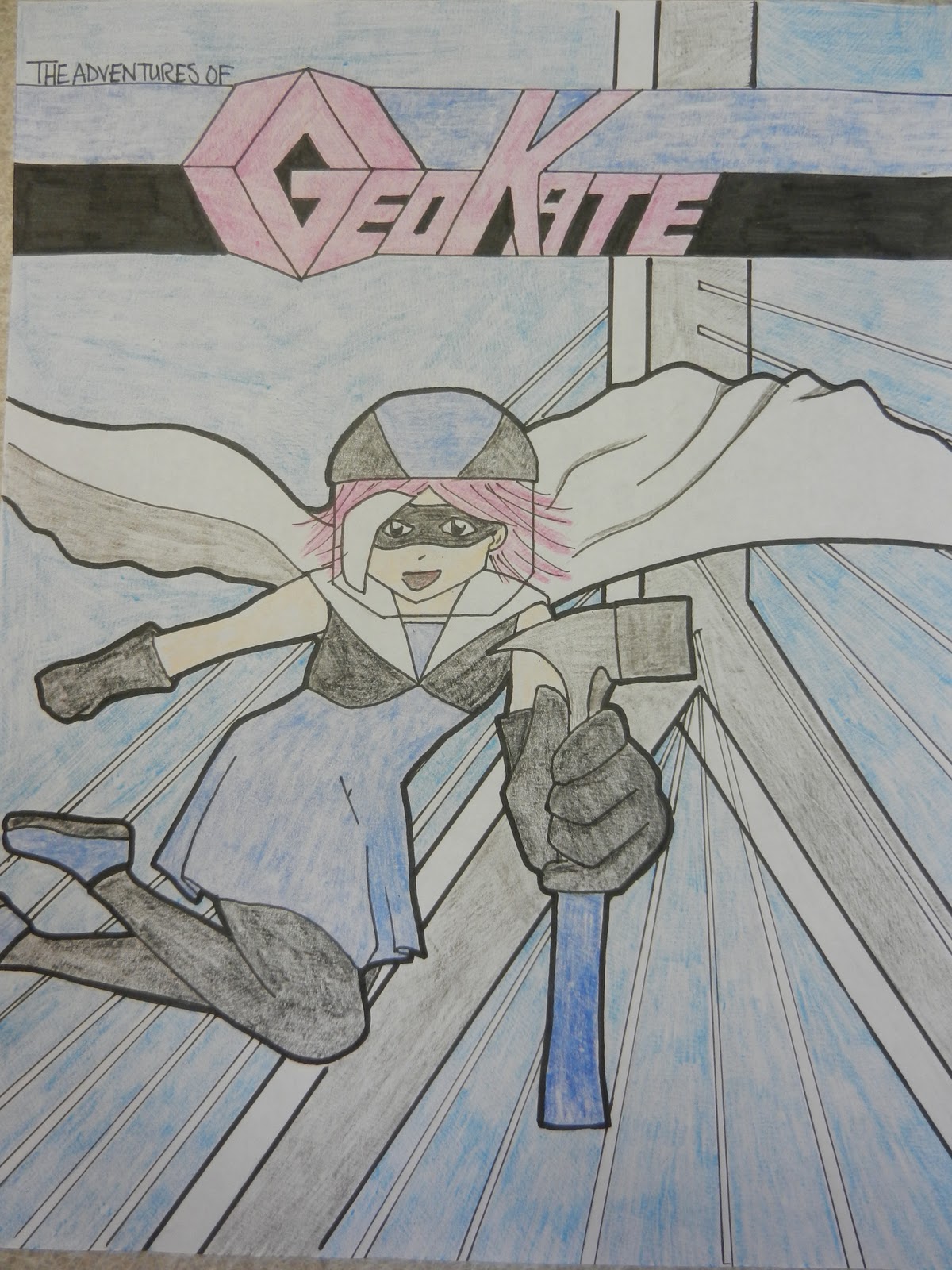
I got mail today in my box at school.  I LOVE getting mail, but especially when it is birthday mail from one of my best friends.  Inside the envelope I found some fun birthday notes and cards and then all of a sudden I spotted this masterpiece:
Cover Page for the Comic "The Adventures of GeoKate!"
Not only am I outfitted as a super-hero geochemist (complete with my awesome purple/blue lab clogs, rock hammer, and stylish face shield to protect my face from hydrofluoric acid), I also have the power of flight fueled by reading journal articles.  Knowledge is power, after all!  (Is there really ANY question why she's my best friend?!)

You better believe this went straight up on the wall in my cubicle.

Beyond Boston: New Hampshire IV Retreat

After a weekend away and a busy beginning to this week (first exam as a grad. student and beginning to learn partial dissolution procedures in the clean lab!), I am just now writing about this past weekend's adventure.

I took the opportunity to get out of Boston and see part of neighboring New Hampshire.  Intervarsity offered graduate students from around Boston the opportunity to go on a fall retreat to the Toah Nipi retreat center, near Rindge, New Hampshire from Friday night through Sunday afternoon of the long weekend.

View from the Beach
Toah Nipi means "wide waters" in the Algonquin language.  It has long been a meeting place where people came together, whether from the Algonquin people or attending modern retreats and camps.  In fact, a birch-bark canoe recovered from the location attests to the rich heritage of the site.  The buildings are surrounded by woods containing miles of hiking trails on all sides and are near a beautiful lake rimmed by trees just beginning to change colors.  


Becca canoeing!
Almost 200 graduate students were in attendance for the weekend event.  We had all kinds of activities spanning everything from fun and games to worship and learning.  On Saturday we had free time, which I filled with canoeing on the lake, an hour-long hike in the woods, helping to assemble apple pies for dinner, and many rounds of the game Bananagrams.  Other fun activities included a late-night game of Dutch Blitz (that I won!), group games with BU GCF, and a Jack-O-Lantern carving contest between the groups from different schools.  We also had meaningful times of worship, joined in group Bible study with other graduate students from our own schools, built friendships while having fun and around the campfires, and received invaluable advice from people who have been where we are now and are willing to share their experiences by serving on a mentor panel.  We were also challenged to seek balance in our lives and to live now like we want to live the rest of our lives.

Campfire on the beach
On Sunday, I also happened to be celebrating my birthday while on the retreat!  At breakfast they surprised me with a large square of coffee cake and candle and sang happy birthday.  I don't think I could have asked for a better way to spend my first birthday of graduate school than building friendships and being challenged to grow.

It was wonderful to be able to leave behind some of the worries and stresses of graduate school for the weekend.  Don't worry though- I am a geologist through and through.  As I sat on the beach on Sunday morning, I found myself looking down at the sand around my feet and thinking "I wonder how much garnet I could separate out from this sand in the mineral separation lab...." then proceeded to sort through a handful to find a grain to show to a friend so she could see what I am studying!
Ever the geologist...."How much garnet is here?!"


Sunday, October 2, 2011

Piles of Sand

Am I doing any work or just exploring the city? What have I been up to in the lab?  I'm so glad you asked, and I have an answer for you this week.  Prepare yourself- this is a (lengthy) science update post!

I am now officially one month into my time here in Boston.  Besides adjusting to life as a grad. student, life in a new city, and my two classes for the semester (geochemistry and a mathematical modeling course), I have plenty of ambitious research goals for the semester.  In fact, I have at least four projects that I am supposed to be starting or working on at some point in the next couple months.  I have a feeling you'll hear about them over the coming months..or years.

But before I can produce large amounts of relevant data in the lab, I am currently in that joyous stage of being the newbie, the trainee, the person who has no idea how to do most of the routine procedures in my new lab and has to ask someone for help every time I come up against the next step.  Clearly there are some benefits to that situation (like being limited in what labs I have been trained in so therefore feeling no guilt at not spending every waking moment in the lab or the constant learning of new and exciting things) as well as drawbacks (like not being even remotely self-sufficient and making slow research progress).  I have been assured by my adviser that it could take me a good year to two years until I can confidently handle any and all of the research tasks expected of me- so I suppose I am doing well for a month in. It's all about perspective.

That being said, I am happy to share with you what I have accomplished this month in the lab.  Really, it all centers on making piles of sand.

Glen Clova, Scotland
The first of my four projects involves sand collected from a river flowing through Glen Clova, Scotland.  Glen Clova is a famous glacially-carved, U-shaped valley and is part of the type locality for the Barrovian metamorphic sequence.  I visited in June and collected the sample, along with my adviser and field assistant.  (If you missed my post on summer fieldwork and want to see more details on my trip to Scotland or pictures, check it out here.)  The current goal for the sample is to separate out the mineral garnet and attempt to establish an age for individual garnet grains.  This sample will be a part of the method development for my dissertation.  My overall PhD project is focused on developing a system for dating detrital (eroded and then redeposited elsewhere) garnets, which has essentially never been done and would open a whole new tool for geochronology.

The first step is taking my bucket of sand and separating out the grains of garnet from the overwhelming amounts of quartz, feldspar, and other minerals present.  While you could theoretically just sit there with tweezers and hunt through the bucket, that would be terrible and not very efficient.  Therefore, we can use properties of the minerals to separate them into different "piles."  Many geologists (and most prospectors) have gone through a similar series of steps as a part of the basic sample preparation that is my current lab activity.

The first step is to send the sand through sieves with different size mesh screens.  This divides the grains into piles with similar grain sizes.  This is important not only for later mineral separation steps, but allows me to gain an idea of the grain size distribution for garnet in this sample.  Since I am developing a new method that uses a single grain of garnet at a time, I would ideally like to find the largest grains that exist to start with, before working down to smaller grains.  Also, since my samples have much larger grains than what my lab is used to working with (finely crushed "pure" garnets), I got to determine that we need some sieves with larger mesh sizes and order them.  Thus, my first contribution to making my lab more versatile! Hooray!

Once the grains are separated by size, I have been using a Frantz electromagnetic separator to divide the grains based on magnetic susceptibility.  Most mineral grains are magnetic to at least a small degree, especially if you use a big enough electromagnet and set it appropriately.  The differences in magnetic susceptibility between minerals of different types allow sand to be separated into piles based on the degree of magnetism.
The Frantz I've been using the past couple weeks
Here's how it works:

  1. Clean the machine thoroughly.  (You definitely don't want grains from the previous user's sample contaminating your sample!)
  2. Turn on the magnet and set the desired level of magnetism.  Since I'm aiming for garnet, I usually start with a high setting to eliminate the least magnetic minerals and work my way towards gradually eliminating more magnetic minerals.  People who want to separate out other minerals may approach it differently.
  3. Load whatever sample you wish to separate into the glass container that will feed the grains into the machine.  Usually you want to use a hand magnet on this sample before you load it, because that will remove one mineral (magnetite) that is the most magnetic and keep very magnetic grains from sticking to the magnet.
  4. You can control how quickly the glass feeder container and a tray between the two portions of the electromagnet vibrate to control how quickly grains move through the magnet.  Grains fall out of the feeder (ideally basically one grain at a time so they don't influence one another) and move down a tray between the electromagnet.  The tray is tilted so that by gravity, grains prefer to move down the side away from the operator.  However, grains that are more magnetic than the magnet's current setting will be pulled up to the portion of the track closer to the operator.  The grains are then separated into two containers at the other end- the closer one being more magnetic and the one further away less magnetic.
  5. Since I want garnet I continually rerun the pile collected in the container closest to me at a lower magnetic setting so that it is separated into two new piles.  This continues until I have one or two piles that have a larger proportion of garnet than any of the other piles.
Some people use heavy liquids or water tables to separate minerals by density and to reduce the amount of time required and increase the efficiency of the Frantz.  We have been discussing having me implement these strategies in our lab eventually, especially since I may have to separate relatively large amounts of sand.  We shall see what the future holds.

I also got to make another contribution to improving my lab's efficiency by constructing a "backboard" to keep my grains from bouncing out of the Frantz as they dropped out of the feeder.  Evidently the combination of larger grain size plus an old Frantz model leads to quite a few grains trying to jump ship before they head down the tray- regardless of how high or low the vibration of the feeder and tray is set.  I improvised a shield from weighing paper and label stickers- nothing like scientific McGuyvering.

That pretty much sums up month one in the lab.  So far it has been basic sample processing (all of which I actually did once upon a time as an undergrad. for a term project) but at least it's progress!  I'll share the next step for these piles of sand in an upcoming post.

Sunday, September 25, 2011

BEE #4: The Museum of Fine Arts, Boston (MFA)

Saturday, Sept. 24th was Smithsonian magazine's Museum Day.  Museums across the country offered two free admissions per household if you simply registered in advance and printed off your voucher.  I looked into it and found that of the participating museums in Boston, the Museum of Fine Arts (MFA) was on the list!  I registered and received two free tickets, one for me and one for my roommate (a $40 value for free!).

On Saturday we headed for the museum by T (the public transit system).  The museum is located off of the Green E line, so we had to transfer to get there.  Unfortunately, the station that looked like it should connect us to the correct line on the maps did not allow you to pass from the inbound to the outbound platform, which is what we needed.  So instead we ended up going up to street level and walking a couple of blocks to the next station, where we made the transfer successfully.  Turns out this was an added bonus!  We got to see another part of the city (a portion of Back Bay) that we will return to for a future adventure...

We arrived at the museum, turned in our vouchers for tickets and entered.  The MFA offers free coat-check, so we were able to get rid of our jackets before setting off to view some art.
Me in front of one of the entrances to the MFA
The MFA is BIG.  Granted my roommate and I are both "sign-readers"...so it takes us a little longer than most people to get through an area.  However, we probably only got through about a fourth of the museum in a 4-5 hour visit!  I will just have to come back in the future, but for now I'll share what I saw in my first visit.  On this trip we saw the exhibits on jewelry and musical instruments, the Linde Family Wing for Contemporary Art, and a special exhibit of five works by Monet.

Both the jewelry and the musical instruments are housed in two small exhibits near the Huntington entrance to the museum.  The jewelry exhibit contains everything from a jewelry set that belonged to Mary Todd Lincoln to a box decorated in exquisite amber cameos to a set of pieces that included taxidermy hummingbirds in their design!  Many of the pieces were either very beautiful or rather unusual and were well worth the time we spent looking at them.  The old musical instruments exhibit included a couple of pieces that stood out to me among a lot of less interesting but historically relevant instruments.  My favorite in the room was the rotating glass bowl instrument that Benjamin Franklin designed to reduce the effort necessary to produce the sound made by rubbing a wet finger around the rim of a goblet.  The intricately decorated grand piano and inlaid guitar were also some of my other favorites in the exhibit.

We then headed to the Linde Family Wing for Contemporary Art.  This wing of the museum is new and just opened in about the last month.  It provides a home for more modern pieces of art that range from statues to neon signs to the odd and slightly weird.
"All Art has been contemporary"
The neon sign on the wall says "All art has been contemporary," which makes a good point.  I think highlights of the wing included a work made out of bottle caps and aluminum bottle labels that resembled a topographic map, a twisted hand-carved clay sculpture, a lattice-work basket made of Pyrex rods, and a piece supposed to resemble an ice flow.  For the ice flow piece the artist had traveled to the Arctic and recorded the sounds of bubbles and water moving under the ice.  She then made it into low frequency vibrations, so that when you sat on the ice flow mold, you could feel and experience being on an ice sheet!  (If you noticed...a couple of the pieces I just mentioned could be linked to science....lol.)

We got lunch at the cafeteria in the museum and ate it in an outdoor courtyard.  Then after lunch we finished the contemporary wing, walked around to explore the layout of the rest of the museum.  Here is my favorite staircase we discovered in our wanderings.
Staircase in MFA, lined with vases
Finally, we visited a special exhibit that was in its last two days at the MFA.  The special exhibit displayed five works by Monet and five by Lichtenstein all inspired by the Rouen Cathedral.  Monet painted the cathedral from five varying perspectives with different lighting.  Lichtenstein then drew inspiration from Monet's five paintings about seventy-five years later and created images of dots silk-screened over a base color to echo the outlines of the cathedral recorded by Monet.  The contrast between the classic works by Monet gathered from museums around the world (all together in one place!!) and the more modern works by Lichtenstein was very interesting and it was fun to see how the same subject could lead to very different pieces of work!

There is still a lot left to explore.  Besides our wandering to get the layout of the museum, we did not get a chance to explore the Art of the Americas, the European Art, the Ancient Art or the Asian Art wings.  I guess there is always next time! :-)

After we finished at the museum, we took a detour on our way home for a repeat trip to Haymarket (BEE #1).  Nothing beats four nectarines or a bag of lemons for a buck!

Sunday, September 18, 2011

BEE #2&3: Fenway Perspectives

More of the quintessential landmarks in Boston are Fenway Park and The Green Monster.  I knew that I wanted to visit Fenway at some point in my five year stay in Boston and that my brothers have big dreams of coming to visit me so they can visit Fenway...but I didn't exactly expect to be attending not one, but TWO Red Sox games in my second full week at school!  With two games under my belt, I have now experienced Fenway from different perspectives...and I think I might need a Red Sox hat for Christmas if game attendance is going to continue in the future!

Game #1:
Field view from outfield bleachers
My first trip to Fenway involved four tickets that one of my fellow grad. students had to the Wed. Sept. 14th game against the Toronto Blue Jays.  The plan was for myself, my adviser, the new lab manager, and one of my adviser's other students to attend the game after work on Wednesday.  Of course, what they thought was a night game turned out to be a day game!  After much discussion, we decided that playing hooky (shhhh don't tell!) was acceptable to attend the Sox game...as long as we all went back to work after the game and made up for the time missed by working in the evening!  We had seats in the outfield bleachers and it's from there that I got my first look at the Green Monster.

The Green Monster from the outfield bleachers
For those of you unfamiliar with baseball and Fenway Park, the Green Monster is the tall, green wall in left field.  When Fenway was built, the city road on the other side of the wall prevented them from building out, so instead they just built up!  The wall also houses the scoreboard, which is changed manually from inside as well as updates on other games happening around the country, which are manually changed by a worker who exits the wall through a door onto the field between innings.

In my first game I saw my first major league home run, ate an Italian sausage with onions and peppers (which I'm told is a staple), and began to learn the names of some of the Red Sox players.  Unfortunately...I didn't get to experience my first Red Sox win- they lost 4-5.  (Just to set the record straight- we did go back to work afterwards and I spent my evening training in the mineral separation lab..yay!)

Game #2:
My second Red Sox game came on Sat. Sept. 17.  Since I am in a new city, making friends and finding people to connect with has been a priority.  Therefore, I decided to attend an event for BU's Graduate Christian Fellowship group which meant...Red Sox Game #2!

Instead of having tickets already in hand, this time I experienced the "Game Day" ticket sales process.  We met up as a group at BU around one then walked over to Fenway, where we joined a long line of people hoping to purchase tickets for the 4:00PM game.  The Red Sox games have sold out for the last couple of years, so you have to get there early for any hope of getting a seat!  We waited in line for a couple hours talking and getting to know one another until they opened the ticket sales window.  When we got up to the front our choices were $90 seats or $20 standing room only tickets...we're poor grad. students....so I'm pretty sure you can guess what we went with!  After we got our tickets we went straight into the stadium and sat down for a while in someone else's seats to rest up for potentially standing through the game!  This gave me a new perspective on the stadium that I'm sure I could never otherwise afford (note the padded seats...).
View from the padded seats in left field
Once the people came to claim their seats, we got bounced and stood in designated standing room for a while, until we eventually got to sit in different unoccupied seats.  Turns out we landed in a season ticket holder area, where people had chosen not to use their seats that day.  This gave me yet another view of the field, which frankly was my favorite because it provided a good view of the players up to bat:
View from left field bleachers
We had a lot of fun teaching the international students who were with us how the game of baseball works.  We also participated in the time-honored traditions of the seventh inning stretch and the eighth inning singing of Sweet Caroline (which evidently no one really knows the origin of).  A good time was had by all, even down to the Cracker Jacks!

The one downside is that I still haven't seen the Red Sox win!  They lost to the Tampa Bay Rays on Saturday 3-4 in a bit of a nail-biter.  I guess there's always next time....